Kibbe’s 13 Body Types - A Guide to Seeing Yourself Without War
There is something strangely soothing about systems that try to make sense of our forms. We spend years at war with our bodies, chasing silhouettes that don’t belong to us! and then some stylist whispers: “There are thirteen body types, not one. What if you aren’t flawed, just miscategorised?”
Heidi
12/17/20255 min read
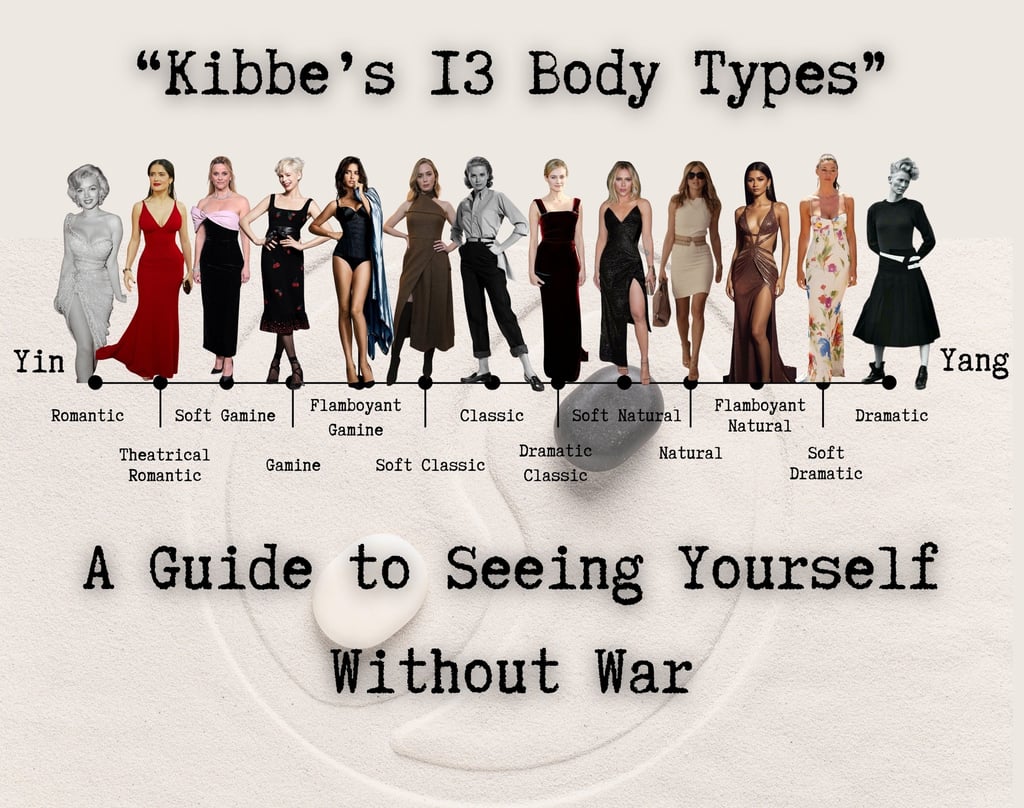
Welcome to Kibbe’s world.
This isn’t about what’s “perfect.” It’s about understanding how your bones, flesh, curves, and angles speak. And the moment you see yourself accurately, suddenly style becomes expression… not punishment.
Why Kibbe Is Different From “Apple, Pear, Hourglass”
Most of us grew up with the usual body-shape labels: apple, pear, hourglass, rectangle, inverted triangle… These focus mainly on where your weight sits and how your curves distribute. They’re useful when you’re choosing things like jeans cuts, waist heights, or how to balance your top and bottom visually. Kibbe, on the other hand, isn’t about “problem areas” at all. It looks at your overall essence: your bone structure, proportions, flesh, angles, and the impression you give in motion. Two women can both be “pear-shaped,” but one might be a Soft Natural and the other a Flamboyant Gamine, and what flatters them will be completely different.
I like to think of it like this:
Use apple/pear/hourglass when you’re doing quick, practical decisions: “Should I go for a high-waist or mid-rise? Do I need volume on top or bottom to balance?”
Use Kibbe when you’re building your style identity: silhouettes, fabrics, lines, the mood of your outfits and how they harmonize with your presence.
Many people feel Kibbe is “better” not because the old system is wrong, but because it’s less judgmental and more holistic. Instead of “fixing” your shape, Kibbe assumes your body is already right, and your clothes are the ones that need to adjust. That shift alone is a tiny revolution.
Below, I’m walking you through Kibbe’s 13 archetypes, in my own words, based on a transcript I studied. Think of this as your poetic field guide.
1. The Dramatic — The Blade of Light
Tall, angular, striking, the Dramatic woman is architecture.
Long lines, sharp bone edges, sleek musculature. She rarely looks “cute”; she looks defined.
She gains weight in the hips and thighs, but never becomes hourglass soft. Her beauty is in her angles, not in lushness.
She is runway energy, not porcelain doll.
2. The Romantic — The Soft Muse
Petite to moderate in height, overflowing with curves.
The Romantic is soft, round, luminous, cheekbones and lips like brushstrokes, arms and legs with flesh.
If she gains weight, she becomes more romantic, not less. Her architecture is sensual.
No hard edges, no sharp angles, everything melts.
She is the poem, not the geometry.
3. The Natural — The Effortlessly Casual
Moderate to tall, slightly blunt in bone but not sharp.
Broad-ish shoulders, straight musculature, almost athletic but not carved.
She rarely gains curves when overweight, instead she becomes square or broad.
She looks like she was born wearing linen.
4. The Classic — The Balance Point
Moderate height, perfectly proportional.
Symmetry is her language, nothing too sharp, nothing too soft.
Not dramatic, not voluptuous, refined.
She is the Renaissance drawing where everything measures out just right.
5. The Gamine — The Pixie Rebel
Petite, angular but narrow, think delicate sharpness.
Often leggy in appearance, long limbs for her size, very large expressive eyes.
When overweight, her shape rounds mostly at the hip and waist, but she never becomes hourglass-soft.
She is small but electric.
6. The Soft Dramatic — The Velvet Blade
Tall like the Dramatic, but draped in flesh.
Long limbs, broad facial bones, yet full lips, lush cheeks, expressive eyes.
She is intensity wrapped in softness, a bold symphony.
Think Cleopatra energy, regal, striking, but undeniably feminine.
7. The Soft Natural — The Warm Breeze
Moderate height, slightly broad bones softened by flesh.
Gentle curves, soft upper arms, thighs, hint of hourglass but not dramatic.
She becomes very soft when gaining weight, hips, waist, and arms filling first.
She is nature, accessible, grounded, serene.
8. The Flamboyant Natural — The Wild Flame
Tall, strong-boned, broad, angular but blunt (not sharp).
Large hands and feet, long limbs, the Amazon archetype.
She doesn’t become curvy; when overweight she becomes square or sturdy.
She is effortless power.
9. The Soft Classic — The Silk Sculpture
Moderate height, balanced proportions, but softened edges.
Rounded shoulders, gentle flesh, delicate features.
She can look “princess-like,” especially when styled with smooth fabrics and grace.
She is Classic draped in velvet.
10. The Dramatic Classic — The Precision Queen
Classic proportions with a whisper of sharpness.
Straight lines, a trim silhouette, slight muscularity, refined facial features.
She tends toward a pear shape when gaining weight.
She is the polished diamond, balanced but edged.
11. The Soft Gamine — The Playful Bloom
Very petite, but both sharp and soft.
Short limbs, fleshy curves, full lips, big eyes, think pint-sized but expressive.
They often think they look heavier than they are because their compact curves exaggerate roundness.
She is a tiny firecracker wrapped in satin.
12. The Flamboyant Gamine — The Graphic Heroine
Petite, bold bones, square or angular shapes, strong limbs.
Features are intense, large eyes, defined jaw, animated expression.
They don’t do delicate, they do statement.
They are contradiction embodied: small scale, big presence.
13. The Theatrical Romantic — The Siren Made Flesh
Petite to moderate, voluptuous curves, but with slight sharpness in the bone structure.
Delicate jaw yet defined, lush lips but sculpted cheeks, their beauty feels cinematic.
Weight gain enhances the hourglass rather than hides it.
She is Romance with eyeliner.
So What Now?
Kibbe doesn’t mean you tick every single box.
If you mostly align with a type, that’s your direction.
This isn’t astrology dressed as styling.
It’s a revolt against the idea that one body is “better.”
Instead, Kibbe asks:
What if style isn’t about correction but celebration?
What if your silhouette is already telling the truth?
That’s where the transformation happens.
My Takeaway
Personally, I find Kibbe’s system less about fashion rules and more about self-reconciliation.
When you recognize your lines, long, soft, angular, compact, bold, you stop forcing yourself into silhouettes that betray you.
The magic isn’t the categories!
it’s the moment you stop apologizing for the architecture you call home.
Final Thoughts
If any of these descriptions made you whisper, “That sounds like me…”
you’re already closer to aligning with your natural presence.
Because style isn’t costume,
it’s harmony between spirit and structure.
And harmony is where confidence begins.
About Me
I’m Heidi, a singer, performing artist, storyteller, and beauty content creator sharing honest routines, ingredient breakdowns, and simple wellness rituals. I love exploring beauty, mental health, travel, and the quiet habits that keep us grounded on and off the stage. My writing comes from real-life experience: touring, concerts, airports, green rooms, and all the messy, magical moments in between. This blog blends research, storytelling, and cruelty-free product recommendations with a performer’s heart.
If you’d like to wander deeper into my world, visit my home page → https://heidivox.com/
Heidi
Showcasing talent and connecting with clients worldwide.
© 2025. All rights reserved.
Follow me